
Wicked: For Good
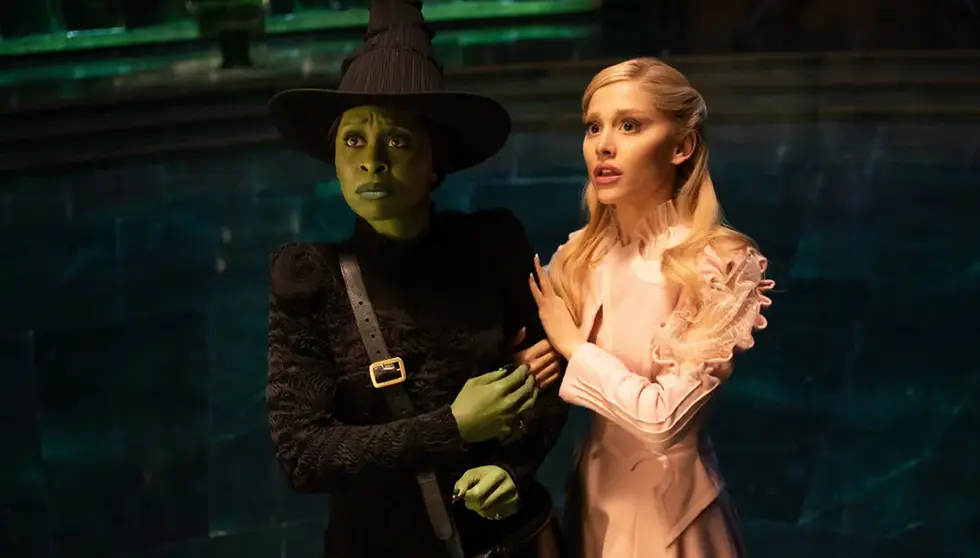
Wicked Part Two, or Wicked: For Good, to give it its proper title, wasn’t as popular with cinemagoers as Wicked Part One – this time around, by the time the theatre reviews for the festive season where done and I had time to head to the cinema, I wasn’t exactly spoiled for choice for screens that were still showing it. But I’m pleased to have discovered the Camden branch of the Curzon chain – it’s a little bit out of the way, below a railway line. Sitting in the screen you can hear the rumbling of trains overhead every so often, if there’s a sufficiently quiet moment in the movie you’re watching. The soundproofing is pretty decent – the train noise didn’t stand a chance of interrupting dialogue.
As for the film, I wouldn’t go as far to say it could have been an email, but it really didn’t need to be two movies either. When the first one ended with ‘To Be Continued’, I felt semi-obliged to see what the continuation was. In terms of narrative, more goes on than in the stage show – as it should, frankly, as it has double the amount of time to tell the same story. But, without going into a blow-by-blow comparison between the movie and the stage show, the film has additional songs, sticks in a wedding I don’t recall from the musical and there’s a twist at the end that Wicked fans (of which I am not one) might well wish to discuss between themselves.
I’ve been told about apparent ‘whitewashing’ of the second movie. I don’t mean the dark-skinned Prince Fiyero of the Gregory Maguire novel being played by Very Sexy White Man Jonathan Bailey in the films. Bailey, by the way, is woefully underused in the second one. I mean a distinct lack of colour in the second film, compared to the first one, let alone the 1939 MGM film The Wizard of Oz. Judging by the list of credits at the end, it appears this was a film that used actual sets rather than CGI (or even worse, AI), but to what purpose – if it all looks a bit beige and shadowy, as though everything were in underground tunnels? Were they trying to save money on lighting or something?
Michelle Yeoh’s Madame Morrible, the press secretary to Jeff Goldblum’s Wizard of Oz, probably should have had her singing voice dubbed. Harsh, I know, but that’s just the truth, especially when she’s starring alongside the likes of Ariana Grande’s Glinda and Cynthia Erivo’s Elphaba. Grande and Erivo’s off-set antics made me wonder if they ought to be subjected to spells in rehab, but there’s no denying those ladies can sing. Perhaps the best difference between the stage show and the motion picture is that everything can be heard with crystal clarity in the latter. Though even this had its pluses and minuses: for example, I found myself chortling at a lyric in ‘For Good’ – “Like a seed dropped by a sky bird / In a distant wood”. What?
Deliberately mispronounced words were not in the least bit amusing to me, and while I’m still glad I saw it, thinking about the way it was put together, it had the hallmarks of a war film. There are battle sequences. There is destruction on an epic scale. There’s even a mass evacuation scene as ‘everyone’ flees to safety, refugees escaping tyranny. Merry flipping Christmas. And yet, it seemed two hours and eighteen minutes well spent. The eternal struggle between good and evil is portrayed with nuance and dramatic tension, even it is padded out.


Comments